


LOCATION OF THE PAIN SU JOK POINTS 16

CONNECTION OF THE ORGANS AND BODY PARTS WITH THE SPINE 15
July 14, 2016
STIMULATION OF THE PAIN POINTS 17
July 15, 2016
2. LOCATION OF THE PAIN SU JOK POINTS
You can find the pain su jok points in the correspondence zones with a simple instrument, called diagnostic probe or with a proper object at hand.
The diagnostic probe serves for location and massage of the pain points on the hand and foot. It is a stick made of metal, plastic or wood, about ten centimetres in length. Its both ends are spherical, with roundness 2-4 mm. One of the spheres is with larger diameter and is used on the soft parts of the hand. The smaller sphere is used on the areas, where the bones are close to the skin.
If you don’t have a probe, you can use a match, the thin end of a thermometer or other appropriate object at hand with a rounded tip and 2-3 mm in diameter. With a little practice you could locate the su jok points even with a nail.
♦ Look for the pain points as you carefully go through the outlined correspondence zones with the diagnostic probe.
Go through the zone as you press the probe vertically, with the same intensity and move it slightly. Move the probe consecutively and methodically – as if you mow a lawn, with a step equal to the diameter of its tip. Don’t leave an unchecked area. The pain points are small and could be easily missed. That is why it is very important to explore the zone methodically, not just to wander about it randomly.
When you look for the pain points pay attention on the following:
- The probe’s pressure should not be too intensive, because then you will feel a pain everywhere you press. Start with a slight pressure.
- It is possible after you go through the zone for the first time not to find a pain point. Then repeat, as you make the pressure stronger and change the angle of pressure.
- In the knuckles area look for the pain su jok points by bent and stretched fingers (toes) trying to check as deep as possible the space between the knuckles.
- In the area of the soft tissues (for example the palm) use the big end of the probe and more intensive pressure so you can “feel” the bones underneath.
- You can also explore the zone as you “slide” the probe on the skin. When its tip goes over a pain point you will feel that clearly.
- In the hand and foot areas where the skin is close to the bones, for example the upper side of the fingers, you can easily locate the pain points as you roll over them the side part of the probe.
- If it is a large zone, first explore it with a strong vertical pressure of the thumb. Normally the area, where the pain points are located, is tender. Then check this spot with a probe very thoroughly.
Remember that the correspondence zones are similar and proportional to the organs and parts of the body that they correspond to, and the position of the pain points on them corresponds geometrically to the position of the disease’s focus on the diseased organ.
For instance, if your gastric ulcer is in the upper part of your stomach, look for pain points in the upper part of its correspondence zone. Or if you have pains in the middle part of the thigh – look for pain points in the middle of its correspondence zone etc.
► When the disease’s focus is close to the skin or on it, look for the pain points proceeding from the skin correspondence, and when it is in the internal organs and in the deeper located tissues follow the bone correspondence.
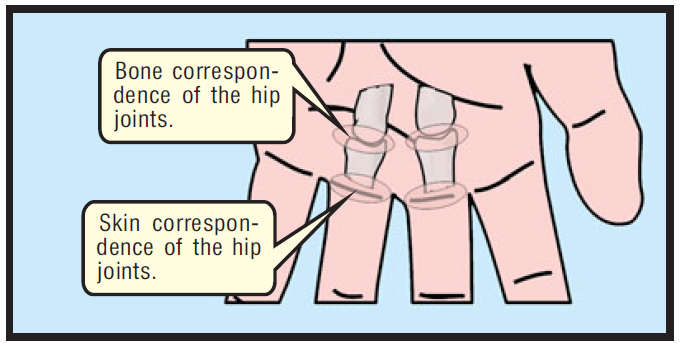
Finally you will locate one or several pain points. If there are several points – one of them will be most painful. When this point is pressed, the pain is sharp, sometimes unbearable. The pain is more intensive by acute diseases and slighter by chronic ones.
Mark the located points and outline the most painful one.
Sometimes the pain points are so close to each other that they become one and form larger pain area. Normally the middle of the area is most painful and corresponds to the most painful point.
The epicentre, the focus of the disease is projected on the most painful point. Its stimulation attacks this focus directly and has a powerful healing effect. We can compare the other not so painful points with the glowing embers lying around the fireplace. When we try to work on them, to put them out, this will only abate the warmth of the fire but won’t extinguish it because the focus will be still untouched. For that reason the right determination of the most painful point is so important.
You can find out if you have defined the most painful point correctly after you stimulate it experimentally. The stimulation of this point brings comfort practically always and immediately.
Note: The outlining of the most powerful point is of great importance when the stimulation is with needles, massage, seeds or magnets, because in this case it is absolutely necessary not to miss the point. By stimulation with moxa the exact location is not so essential because in practice all pain points in the warmed area are stimulated simultaneously.
If you don’t find pain points in the correspondence zones of a diseased organ is quite possible your disease to be inaccurately diagnosed. There are ALWAYS pain points in the correspondence zones of a diseased organ. In case the diagnose is beyond doubt it is possible the pain points to be located deep under bone structures that hinder their easy location, or in the soft parts of the hand under thick tissue layer. It is possible that you haven’t found these points due to lack of experience.
The pain su jok points have also a diagnostic value. If you find pain points located in the same way in all correspondence zones of an organ in the both correspondence systems – the Main and “Insect”, it is quite possible this organ to be diseased.


